NanoClaw 架构设计深度解析
NanoClaw 架构的核心洞察是:与其构建复杂的插件 API 来限制扩展的能力,不如利用 Git 的成熟合并机制来安全地组合任意代码变更。 AI(Claude Code)只在 Git 无法自动解决冲突时才介入,而且解决方案会被缓存(git rerere)以便下次自动应用。这使得大多数用户永远不会遇到未解决的冲突,同时保留了无限的定制能力。
提示词(Kimi-2.5 Agent):
我没有理解 NanoClaw 这里的架构设计,结合源代码(https://github.com/qwibitai/nanoclaw )仔细研究一下,给我讲明白。
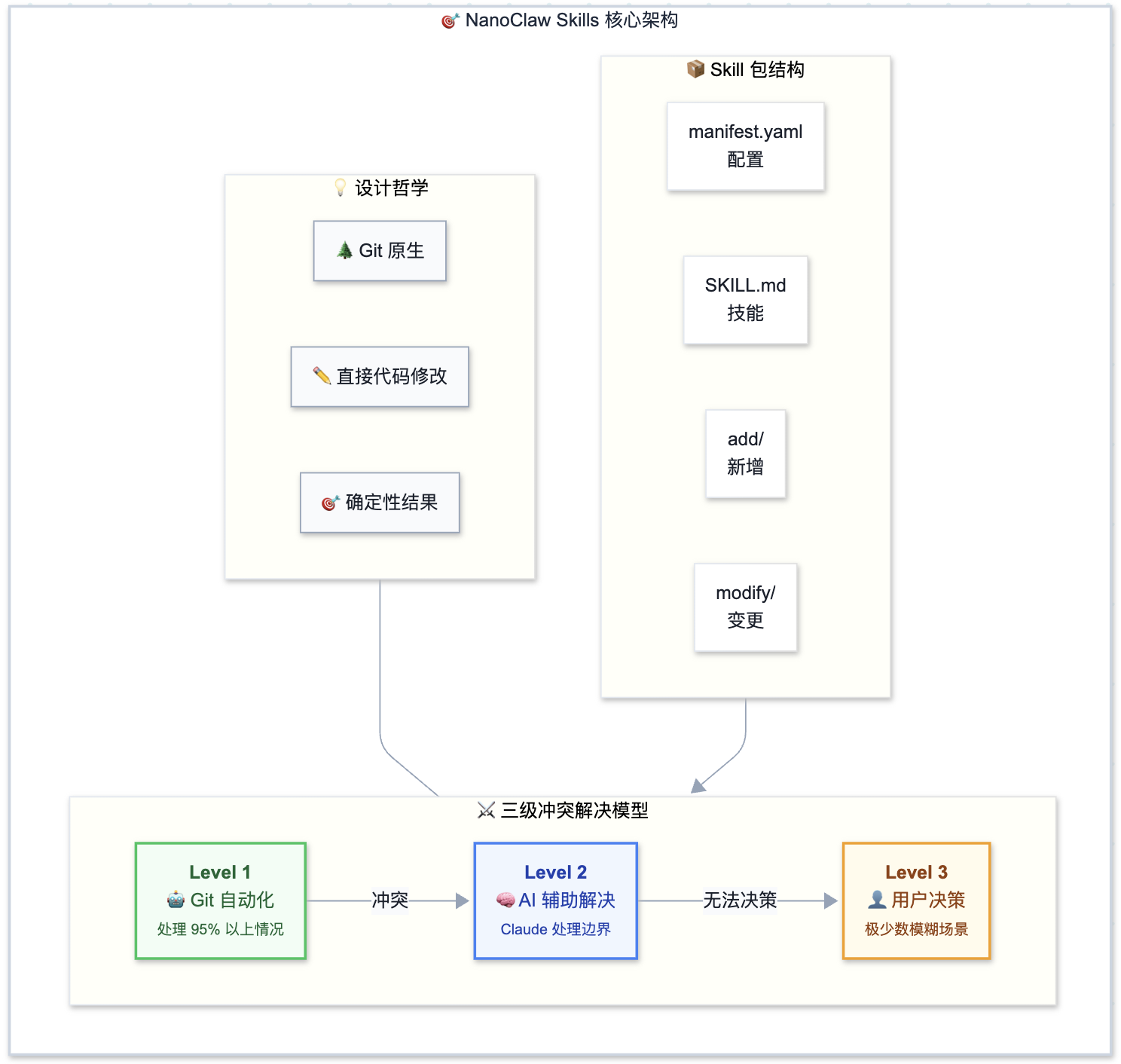
---
config:
  theme: base
  themeVariables:
    primaryColor: '#ffffff'
    primaryTextColor: '#1a202c'
    primaryBorderColor: '#e2e8f0'
    lineColor: '#94a3b8'
    secondaryColor: '#f8fafc'
    tertiaryColor: '#ffffff'
    fontSize: 14px
---
flowchart TB
 subgraph Philosophy["💡 设计哲学"]
    direction LR
        Git["🌲 Git 原生"]
        Direct["✏️ 直接代码修改"]
        Deterministic["🎯 确定性结果"]
  end
 subgraph ConflictResolution["⚔️ 三级冲突解决模型"]
    direction LR
        L1["<b>Level 1</b><br>🤖 Git 自动化<br><small>处理 95% 以上情况</small>"]
        L2["<b>Level 2</b><br>🧠 AI 辅助解决<br><small>Claude 处理边界</small>"]
        L3["<b>Level 3</b><br>👤 用户决策<br><small>极少数模糊场景</small>"]
  end
 subgraph SkillPackage["📦 Skill 包结构"]
    direction LR
        Manifest["manifest.yaml<br>配置"]
        Intent["SKILL.md<br>技能"]
        Add["add/<br>新增"]
        Modify["modify/<br>变更"]
  end
 subgraph SkillSystem["🎯 NanoClaw Skills 核心架构"]
    direction TB
        SkillPackage
        ConflictResolution
        Philosophy
  end
    L1 -- 冲突 --> L2
    L2 -- 无法决策 --> L3
    Philosophy --- ConflictResolution
    SkillPackage --> ConflictResolution

    style Deterministic fill:#f8fafc,stroke:#94a3b8
    style Direct fill:#f8fafc,stroke:#94a3b8
    style Git fill:#f8fafc,stroke:#94a3b8
    style L3 fill:#fffbeb,stroke:#f59e0b,stroke-width:2px,color:#92400e
    style L2 fill:#eff6ff,stroke:#3b82f6,stroke-width:2px,color:#1e40af
    style L1 fill:#f0fdf4,stroke:#22c55e,stroke-width:2px,color:#166534
    style SkillSystem fill:#ffffff,stroke:#cbd5e1,stroke-width:2px,color:#1e293b
一、项目定位:什么是 NanoClaw?
NanoClaw 是一个个人 Claude 助手,通过 WhatsApp 访问,具有以下特性:
- 持久化记忆(按对话分组)
- 定时任务调度
- 容器隔离执行环境
- 基于 Anthropic Claude Agent SDK
它的设计哲学是 "小到可以理解" ——整个代码库应该可以被一个人阅读和掌握,而不是像 OpenClaw 那样变成复杂的微服务架构。
二、核心架构:双层隔离模型